Attract More Paying Clients With "Belief-Shifting" Content Marketing
By Andrew Lane
Founder of Design Hacker
It's a familiar saga...
You invest countless countless hours crafting content, only to watch it collect dust while your offer goes ignored.
But what if the problem isn't the quality of your content, but the unspoken objections in your audience's minds?
I've been there: pouring my soul into blog posts, videos, and social content, only to hear crickets when I finally made my offer. It was exhausting, demoralizing, and made me question everything.
But then I uncovered the psychological secret weapon that transformed my business. It's called "belief-shifting" content, and it's about to revolutionize how you approach your content strategy.
Here's the secret:
If your audience doesn't share the core beliefs that make your product or service undeniably valuable, even the most polished, well-optimized content will fall short.
If you've been struggling to turn content consumers into paying customers, this article will arm you with the framework to craft messages that overcome objections and inspire belief in your solution.
It All Comes Down To "Hidden Beliefs"
Hidden beliefs are the subconscious doubts, assumptions, and objections your audience has that act as invisible barriers. They might think their situation is too unique, your solution won't work for them, or that they don't have what it takes to see results.
Without addressing these hidden beliefs, even your best content won't resonate. But what if you could design content that methodically shifts those beliefs, turning your audience into eager, enthusiastic buyers?

Imagine what could happen if you designed content specifically to break down those walls. Content that shifts their mindset, making them eager to work with you. That's the power of "belief-shifting" content marketing.
Example: Meditation Course
Target Customer: Someone interested in reducing stress and improving focus, but hesitant to commit to a meditation practice.
Hidden Beliefs to Address:
Belief 1: Meditation is "woo-woo" and not scientifically proven.
Belief 2: Building a consistent meditation habit is too difficult.
Belief 3: They can manage stress on their own without additional support.
Shifting Beliefs Through Content:
Now, craft your content topics to directly address and dismantle these hidden beliefs.
Content Idea 1: "The Science Behind Meditation: Why This Ancient Practice is Backed by Modern Research" (Addresses Belief 1)
Content Idea 2: "5-Minute Meditation Hacks You Can Do Every Day (Busy Schedule? No Problem!)" (Addresses Belief 2)
Content Idea 3: "The Power of Community: Why Guided Meditation Programs Can Help You Succeed" (Addresses Belief 3)
Benefits:
Attract the Right Audience: Content focused on belief-shifting attracts viewers who are genuinely interested in overcoming their doubts, making them more receptive to your solution later.
Build Trust and Credibility: Addressing their concerns head-on establishes you as a reliable source of information and positions you as the expert who can help them achieve their goals.
Warms Them Up for Your Offer: By the time viewers see your call to action (e.g., enrolling in your meditation course), they'll be primed to believe in the value it offers and see it as the solution to their addressed doubts.
Remember: Don't just tell people what to do; show them why it matters and how it can overcome their specific roadblocks. This method goes beyond simply "providing value" by strategically creating content that gets them curious about your offer.
Pretty powerful right?
The Content Divide: Traditional vs. Belief-Shifting
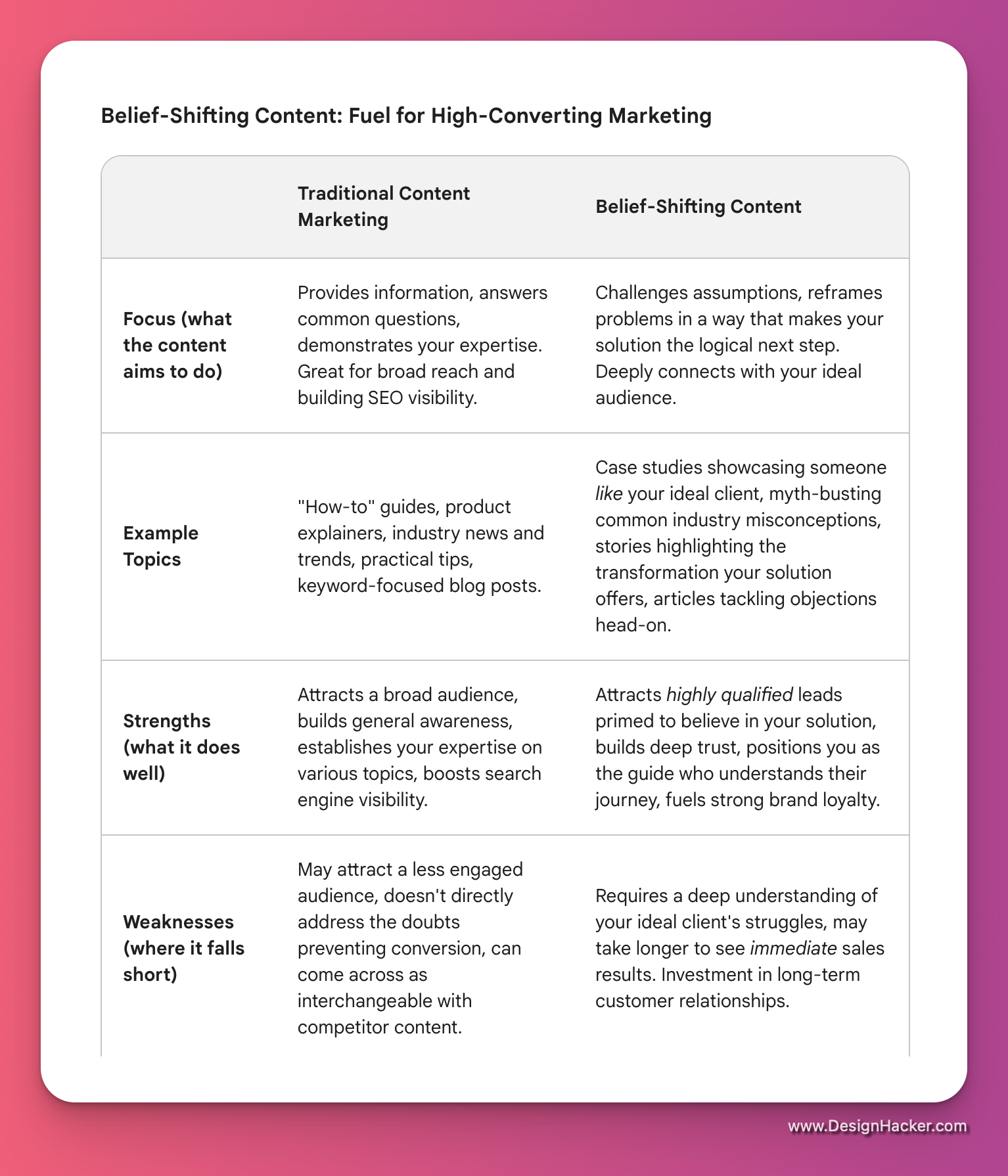
Here's the key: traditional content can inform and educate, but without addressing the hidden beliefs holding your ideal customer back, you're missing out on its true power. Let's break down the two main types of content and why one has the potential to transform your marketing results.

Let's break down what we mean by "traditional" content. This includes:
"How-to" Guides and Tutorials: Step-by-step instructions, solving practical problems (e.g., "How to Set Up a Newsletter").
FAQs and Informative Articles: Answering common questions directly, providing clear explanations (e.g., "What is the Difference Between Coaching and Consulting?").
Product/Service Explainers: Outlining features, benefits, and how your offerings work.
Industry News and Trend Reports: Keeping your audience updated on relevant developments.
The Value of Traditional Content
This type of content is essential for several reasons:
Establishes Expertise: Demonstrates that you know your stuff.
Builds Awareness: Introduces potential customers to your brand.
Improves SEO: Optimized content helps you rank higher in search results.
Where Traditional Content Falls Short
While valuable, traditional content alone has limitations:
Can Feel Generic: Without going deeper, it's easy to blend into the noise of similar content.
Doesn't Address Root Causes: Answers the "what" and "how," but may not tackle the "why not?" that prevents action.
Limited Emotional Impact: Primarily informs, but might not create a strong desire for your specific solution.
The Transformative Power of Belief-Shifting
Belief-shifting content is where the real magic happens. This approach focuses on:
Challenging Limiting Beliefs: Tackling assumptions like "This won't work for me" or "I can't afford it."
Reframing Problems: Showing how your solution becomes the obvious, exciting next step.
Creating "Aha!" Moments: Providing insights that shift your audience's perspective.
The Bottom Line
Traditional content lays a strong foundation. Belief-shifting content is what turns that foundation into a thriving, loyal customer base.
Are you ready to uncover those hidden beliefs holding your audience back? Let's dive in and transform your content strategy!

Here are some steps you can take right now to implement this in your own business:
Step 1: Identify the Hidden Beliefs
Before crafting belief-shifting content, take time to uncover the specific roadblocks your target audience faces:
Customer Feedback: Surveys, interviews, and analyzing past client objections can offer a goldmine of insights into common doubts.
Community Observation: Delve into online forums, social media groups, and review sites where your ideal customers hang out. What objections and misconceptions do they voice?
Competitive Analysis: Examine how competitors address those beliefs (successfully or not) – their materials can reveal hidden assumptions in the market.
Example: Productivity Coaching
Target Customer: A busy professional overwhelmed by their workload, feeling like they're constantly spinning their wheels without getting any real traction.
Hidden Beliefs to Address
Belief 1: "Being busy equals being productive."
Belief 2: "I'll never catch up. There's simply too much to do."
Belief 3: "Success means doing it all myself."
Shifting Beliefs Through Content
Content Idea 1: "The Productivity Myth: Why Working Harder Isn't the Same as Working Smarter" (Addresses Belief 1)
Content Idea 2: "Time-Blocking for Sanity: How to Reclaim Your Schedule and Achieve More" (Addresses Belief 2)
Content Idea 3: "The Surprising Power of Delegation: How Letting Go Can Actually Boost Your Results" (Addresses Belief 3)
Step 2: Craft Content That Shifts Beliefs
Once you understand the hidden beliefs, it's time to design content that tackles them head-on:
Case Studies: Share the success stories of clients who were once in your audience's shoes. Demonstrate how your solution overcame the exact obstacles they now face.
Myth-Busting Articles: Address common misconceptions in your industry with evidence-based articles, dismantling limiting beliefs.
Before-and-After Stories: Illustrate the transformation your solution offers, making the benefits tangible and relatable.
Explainer Videos: Break down your key philosophies and processes, simplifying complex ideas, and replacing doubts with clarity.
Focus on Transformation: Highlight the ultimate change your audience desires, not just surface-level solutions.
Example: Website Design for Small Businesses
Target Customer: A small business owner who wants to improve their online presence but believes a professional website is too expensive or time-consuming to create.
Hidden Beliefs to Address:
Belief 1: "I need a massive, complex website to be taken seriously."
Belief 2: "I'm not tech-savvy enough to build my own website."
Belief 3: "Good web design is out of my budget."
Shifting Beliefs Through Content
Content Idea 1: "Minimalism Matters: Why a Simple, Strategic Website Outperforms a Busy One" (Addresses Belief 1)
Content Idea 2: "No-Code Website Builders: Create a Stunning Site (Even If You Hate Tech)" (Addresses Belief 2)
Content Idea 3: "DIY vs. Done-For-You: When to Invest in a Designer vs. Building Your Own" (Addresses Belief 3)
Step 3: Nurture Their Belief for Long-Term Success
Belief-shifting isn't a one-and-done process. Build a content ecosystem that continually reinforces the right mindset:
Consistency is Key: Regularly publish content that aligns with your core philosophies.
Mix Your Formats: Blog posts, videos, social media snippets, etc., cater to different learning styles and keep your audience engaged.
Build Community: Create spaces where your audience can interact, learn from each other, and celebrate successes – this strengthens their shared belief in your solutions.
Example: Career Transition Coaching
Target Customer: A professional feeling stuck and unfulfilled in their current job but unsure whether a major career change is the right move.
Hidden Beliefs to Address:
Belief 1: "It's too late to change careers. I've invested so much time already."
Belief 2: "I'm not qualified for anything else."
Belief 3: "Taking risks isn't responsible, especially if I have [family, financial obligations, etc.]"
Shifting Beliefs Through Content:
Content Idea 1: "The Sunk Cost Fallacy: Why Staying in a Bad-Fit Job Hurts You More in the Long Run" (Addresses Belief 1)
Content Idea 2: "Hidden Talents: Uncover Your Transferable Skills and Unlock New Career Paths" (Addresses Belief 2)
Content Idea 3: "Calculated Risk vs. Recklessness: How to Plan a Smart, Secure Career Transition" (Addresses Belief 3)
Step 4: The Power of "Aha!" Moments
Go beyond information and aim for epiphanies that shift perspectives:
Counter-Intuitive Insights: Challenge conventional wisdom to create memorable "aha!" moments that dismantle existing beliefs.
Relatable Storytelling: People connect with stories. Show them someone like themselves achieving results they previously thought impossible.
Example: Short-Term Rental Investing
Target Customer: Someone intrigued by the income potential of short-term rentals, but overwhelmed by the perceived start-up costs, regulations, and time commitment.
Hidden Beliefs to Address:
Belief 1: "You need to own property outright to get started."
Belief 2: "Short-term rentals are only successful in tourist hotspots."
Belief 3: "I'll have to handle everything myself – cleaning, guest communication, etc."
Shifting Beliefs Through "Aha!" Content:
Content Idea 1: "Rent Arbitrage: How to Profit from Short-Term Rentals Without Owning Property" (Challenges the ownership assumption)
Content Idea 2: "The Power of Niche Markets: High-Profit Short-Term Rentals for [Birdwatchers, Remote Workers, etc.]" (Expands location possibilities)
Content Idea 3: "Your Neighbor as Your Business Partner: Co-Hosting Strategies to Share Workload and Maximize Returns" (Introduces a collaborative model)
Conclusion: Beyond Content, It's About Connection
Belief-shifting content isn't just a marketing tactic; it's about establishing a deep connection with your audience. By understanding their hidden doubts and fears, you meet them where they are and guide them toward the transformative power of your solution. It's not about pushing products or services; it's about empowering your ideal client to believe in the change they desire.
This approach requires investment – in understanding your audience and crafting content with intention. But the payoff is immense. Belief-shifting content positions you as more than just another solution provider; you become the trusted expert, the one who truly 'gets' them. This builds the kind of loyalty that fuels long-term growth and turns customers into passionate advocates for your brand.
🔥 RECOMMENDED TRAINING:
Turn ANY Idea Into a World-Class Brand Identity In MINUTES With AI
This 3-step system uses AI to build a complete brand foundation for ANY business in just a few clicks.

Hey, I'm Andrew Lane
Founder of Design Hacker
I’ve built multiple 7-figure brands from scratch over the past 15 years. Now I’m using AI to make that process faster, smarter, and way more fun. If you want your brand to feel premium without wasting months or thousands of dollars, then this is for you!